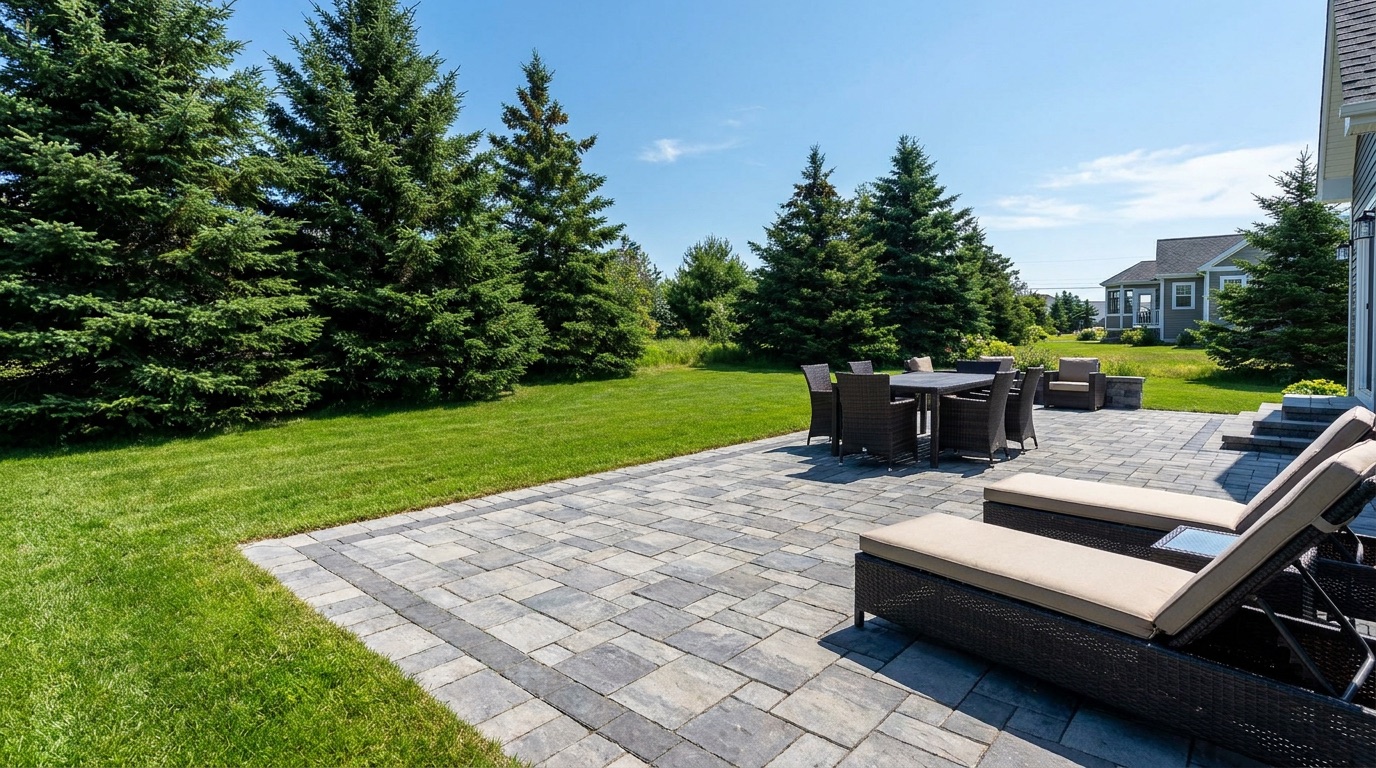
Pavers vs Concrete: Which Is Better for a Halifax Patio or Driveway?
It's one of the first questions homeowners ask us: should I go with pavers or poured concrete for my patio or driveway? It's a fair question, because the two can cost about the same to start, and both look fine on day one.
We install both, so we're not here to sell you one over the other. But after building outdoor surfaces through a lot of Nova Scotia winters, the honest answer is that for most Halifax yards, pavers win — and it mostly comes down to one thing: how our climate treats each one.
Pavers vs concrete: the short answer
Pavers are the better long-term choice for most Halifax patios and driveways, because they flex with the ground through freeze-thaw instead of cracking, they shrug off road salt, and any damage can be repaired one unit at a time. Concrete is worth considering when the budget is tight upfront or you want a large, simple flat pour and can accept that it will likely crack over time in our climate.
The one thing that decides it here: freeze-thaw
Nova Scotia doesn't get one long freeze. We get dozens of freeze-and-thaw swings every winter, and each one moves the ground underneath whatever you built on it.
A poured concrete slab is one big rigid piece. When the ground heaves and settles under it, the slab has no way to move, so it cracks — and once a crack starts, water gets in, freezes, and widens it. A paver surface is hundreds of separate units sitting on a flexible compacted base. When the ground moves, the pavers shift a hair with it and stay intact. That's the whole ballgame in our climate.
Cost: pavers vs concrete
Upfront, plain poured concrete is usually the cheaper option. Paver patios and driveways in Halifax run about $25 to $40 per square foot installed, which covers excavation, a proper crushed-stone base, the sand setting bed, the pavers, polymeric jointing sand, and a contrasting border.
But two things close that gap fast:
- Decorative concrete isn't cheap. Once you add stamping, colour, or a sealed finish to make concrete look like more than a grey slab, the price climbs toward paver territory.
- Cracked concrete gets torn out. When a slab cracks or spalls, the fix is usually cutting out and repouring a section, or the whole thing. Pavers don't get torn out — you reset the affected area. Over 20-plus years, that's where pavers quietly win on total cost.
We'll quote you a real number on either option, free, within 24 hours.
Durability and repairs
On a properly prepared base, paver patios and driveways in Nova Scotia routinely last 25 to 40 years. Just as important, they're repairable. If a spot settles, or a paver gets stained by oil or cracked by something heavy, we lift that unit out and reset or replace it — no visible patch. Keep a few spares from your install and the repair is invisible.
A concrete slab can't do that. A crack can't be un-cracked, and a patch never quite matches. In our freeze-thaw climate, a slab typically shows cracks or surface spalling well before a paver surface would need any attention at all.
Road salt and drainage
Two more Nova Scotia realities favour pavers:
- Road salt. De-icing salt is hard on concrete — it accelerates surface scaling and spalling. Quality pavers are made to handle it far better.
- Drainage. Water drains down through the joints of a paver surface instead of pooling and freezing on top of a slab, which is safer underfoot and easier on the surface.
Looks and home value
This one's partly taste, but paver work reads as a premium, finished feature — the kind of thing that makes a backyard or front entrance look intentional and adds real curb appeal when you sell. We install Techo-Bloc, Oaks, Permacon, and Shaw Brick, so you can match almost any style, from clean modern grey to warm natural stone looks. Plain concrete looks more utilitarian and shows its age faster.
When concrete is the right call
We're not anti-concrete — it's the right choice sometimes:
- You want the lowest possible upfront cost and can accept future cracking.
- It's a large, simple flat surface where appearance and repairs matter less.
- It's a spot that suits a monolithic pour, like a garage floor or a utility pad.
For a patio, walkway, or driveway you want to look good and hold up for decades, though, pavers are the safer bet in this climate.
Our honest take for Halifax yards
If it were our own home, we'd put pavers on the patio and driveway nearly every time. They cost a bit more upfront than plain concrete, but they survive Nova Scotia winters, they're repairable, and they still look sharp 20 years later. The base prep matters more than the pavers themselves — done right, it's a surface you stop thinking about.
Not sure which fits your yard and budget? We'll walk your property, show you samples of both, and send a free written quote within 24 hours. No pressure, no obligation.